
In the blog you find all abstracts of all FROG contributions as well as short biographies of the speakers since 2017. Please use the navigation to access individual entries or use the links in the conference programme.
Marion Plank
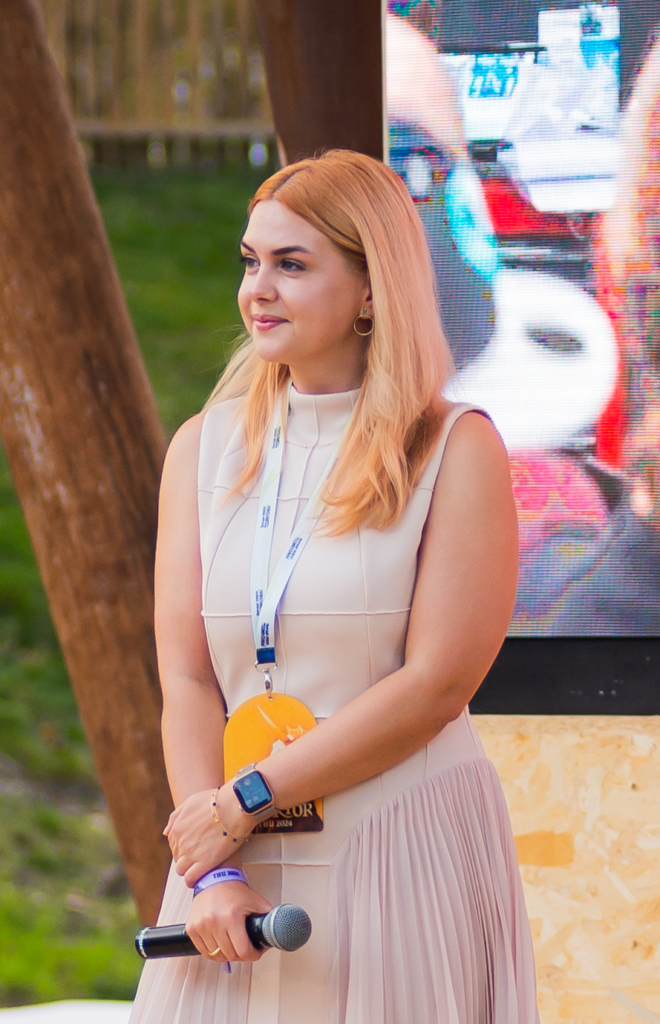
Prof. Marion Plank is a game artist, researcher, and Professor of Game Art at IU International University of Applied Sciences. Her work explores games as artistic and cultural media, with a particular interest in interdisciplinary and experimental forms of game development. She is the initiator of GAMEPATHY, a conference and podcast exploring games, empathy, and society, and co-founded the art and game collective Try&Error. Her current projects investigate the intersections of traditional art, game art, participatory development, and artistic research.
Playing the Painting: From Empty Canvas to Game World
FROG 2026 – Talk
What happens when a painting is not merely represented in a game, but becomes the starting point for a playable system? This presentation examines the interdisciplinary project THE PAINTING, developed by contemporary artist Benjamin Burkard and the student-led game development collective Try&Error, as a practice-based case study in translating analogue art into interactive game space.
The project originated during a 48-hour live development experiment at the Mannheimer Kunstverein, where Burkard’s artistic practice was translated into the prototype “Oxidierter Quellcode”. Its continuation, THE PAINTING, expands this experiment into a narrative game in which surreal paintings, sculptural objects, and artistic processes become environments, mechanics, and objects of interaction. Rather than treating the original artworks as visual assets or reproducing them digitally, the development team asks which formal and conceptual qualities of an artwork can become playable: How can composition become spatial navigation? How can an artistic motif become a mechanic? And what is gained – or lost – when spectatorship is replaced by player agency?
The presentation reflects on these questions through the ongoing collaborative development process between artist, game designers, programmers, and students. Particular attention is given to live development in exhibition spaces (so called Museum Game Jams), where normally invisible production processes become part of the artwork itself. Visitors can observe development, discuss decisions with the team, and play intermediate versions, introducing an additional feedback loop between artwork, developers, institution, and audience.
Finally, the project raises a practical question inherent to hybrid cultural production: How can work situated between contemporary art and game development be funded? Drawing on Try&Error’s experience with cultural funding and game development media funds, the presentation reflects on how projects that cross disciplinary boundaries must also navigate the funding structures surrounding them.
More about the project: http://www.tryanderrorgames.de
Nadine Trautzsch

Nadine Trautzsch is a Professor of Game Design and Game Art. With a background as a visual artist specializing in 2D, UI, UX and 3D, she has been working in the games industry since 2007, creating game worlds and educational apps for children. Since 2017, she has been running her own studio, focusing on concept development, archaeological reconstruction, museum exhibitions and user experience. In her work and projects, she uses interactive storytelling, immersive technologies and game elements to make history and information experiential and to create motivating forms of knowledge transfer. Her research focuses on the game design process and the design of soft metrics such as playfulness, immersion and aesthetic qualities of experience.
Co-Authors:
Project “Tag des unsichtbaren Denkmals” (2019) in collaboration with Tina Lorenz (Management of the ZKM | Hertzlabs) and Markus Wolf
Making the Invisible Visible: Producing Playful Cultural Mediation through Game Design and Immersive Storytelling
FROG 2026 – Talk
This talk explores how museums, academia and game design can collaborate to create playful, immersive and narrative formats for cultural mediation. Rather than understanding such projects as simple gamification, it approaches game design as a method for translating exhibits, reconstructions, historical narratives and cultural memory into experiential spaces.
Drawing on practical projects such as the art project for one day: Tag des unsichtbaren Denkmals, which focused on remembrance culture by making overlooked female historical figures visible as statues, the talk reflects on the collaborative processes behind playful cultural production (https://youtu.be/VVSB_pPQPm4?si=gI-IQRAqN9tLfhDq).
And the Augmented Reality App for self-guided tours, the Donautöchter (https://www.youtube.com/watch?v=ygH3VXqs-Gg) , museum exhibitions designed to make history experiential. These projects required close collaboration between craftspeople, scientists, artists, designers, developers and archaeologists, making knowledge transfer and communication central challenges of the design process. The talk therefore asks which skills, methods and forms of translation are needed when curatorial knowledge, historical research, visual design, interaction design and immersive technology meet.
The focus lies on how game elements, spatial narration and immersive media can support orientation, curiosity, empathy and emotional resonance without simplifying complex cultural material. In these formats, audiences are not only addressed as visitors, but as active participants who move through spaces, follow traces, interpret signs and encounter history through perception and interaction.
The talk argues that cultural institutions are not only places of preservation and display, but can become spaces for participatory, process-based and experiential knowledge production. Producing playing art therefore means designing conditions in which audiences can encounter cultural heritage actively, interpret it through their own perspective and experience history as something situated, embodied and shared.
Kaizhong Cao & Mingyan Zhang

Kaizhong Cao holds a Ph.D. in Engineering from the School of Architecture, Tsinghua University. He is an Associate Professor of Design and a doctoral supervisor at Communication University of China, where he is also recognized as a Young Distinguished Scholar. His research has long focused on digital scene-making for historical and cultural sites. He serves on the Young Editorial Boards of Time + Architecture and Landscape Architecture. He is also a Council Member of the Architectural Society of China, a Member of the Public Art Committee of the Beijing Urban Planning Society, a Young Member of the Chinese Society of Landscape Architecture, and a Member of the Digital Art Committee of the China Artists Association.
Mingyan Zhang is affiliated with the Communication University of China. Her research focuses on digital imaging and explores how digital technologies, gamified interaction, and digital storytelling can facilitate the interpretation and communication of cultural meaning. Her research interests include user experience design, digital cultural heritage, interactive storytelling, and technology-mediated cultural engagement.
Corresponding Author:
Qianhui Wang, Communication University of China
Reimagining a Princely Mansion as Playable Art: Interactive Puzzles for Nighttime Heritage Interpretation
FROG 2026 – Talk
Nighttime cultural heritage tourism often prioritizes spectacle over meaningful engagement, yet the intersection of game design and cultural heritage offers a powerful alternative: transforming architectural ensembles into playable worlds. This paper investigates whether interactive puzzle mechanisms can enable visitors to experience Prince Gong‘s Mansion—a Qing dynasty princely residence whose layered history spans Heshen, Prince Qing, and Prince Gong—as a participatory cultural narrative.
Grounded in embodied cognition and sensory interaction theory, we present a three-phase mixed-methods study. First, a comparative analysis of twelve nighttime heritage projects across five countries yields five design strategy dimensions. Second, we develop a complete design specification for Prince Gong‘s Mansion in Beijing, comprising six puzzle-driven interactive nodes that translate architectural elements—the Western Gate, the Grand Theatre, the Rear Pavilion, and the Fu Stele—into game mechanics. Third, user testing with 40 visitors evaluates the experience.
Results demonstrate that culturally anchored puzzles significantly enhance visitors’ interpretive engagement (Cohen‘s d = 1.58) and emotional connection with the mansion’s historical and artistic layers. The nighttime setting further amplifies focus and sensory immersion. We discuss ethical considerations including cultural authenticity, accessibility, and data privacy.
This work contributes an empirically validated framework for transforming heritage sites into playable art experiences, demonstrating how game design can mediate cultural meaning-making rather than merely providing entertainment. It responds directly to FROG 2026‘s inquiry into how art becomes playable—and how play can deepen our understanding of art.
Elliott Burns

Elliott Burns is an academic and digital art curator based at Central Saint Martins, University of Arts London, who via the online publication Side Quest addresses histories of artist produced computer games. Beyond the art game, areas of expertise include online curatorial practice between Web 1.0 to 3.0 and new media art. He co-founded the online curatorial project Off Site Project and has delivered curatorial / research based projects with Anonymous Gallery, the British Council, the Centre for Investigative Journalism, Distant Gallery, ESPRONCEDA Institute of Art&Culture, Phoenix Art Centre, the Royal College of Art, SummerWorks Festival, and the Victoria & Albert Museum. His writing has been published with DATA Browser, Furtherfield, HAU, Kunstlicht Journal and Outland.
Reactionary Replicas: 30+ Years of the First Museum Shooter
FROG 2026 – Talk
Ever since Orhan Kipcak and Reini Urban digitally modelled the Linz Brucknerhaus in DOOM, the art game genre has seen a near continuous trend of replicating culturally important art institutions within game engine software. This thematic tendency within the genre that was noted and named by Mathias Jansson as the ‘First Museum Shooter’ in 2011, due to the FPS (first-person-shooter) being the modification blueprint for many of these projects and the museum being the zone of artistic display most often re-rendered. However, beyond the aggressive indications of this title, the range of rationals leading an artist to meticulously craft the Arken Museum of Modern Art, Fondazione Prada, König Gallery, MoMA PS1, the Serpentine North Gallery, Tate Modern, the V&A East Storehouse or the ZKM Centre for Art and Media, amongst others, may be expanded upon. Alongside extending and filling gaps in the sub-genre’s history, this paper draws upon theories and practices of institutional critique to address the motivations behind the ‘First Museum Shooter’ and to note upon the form’s continued relevancy. Whilst additionally adopting art historian Griselda Pollock’s notion of the avant-garde gambit and Reesa Greenberg’s analysis of remembering exhibitions, which pathologies the need for institutions to stage exact or modified renditions of past shows, as means to question what other forms of practice the ‘First Museum Shooter’ might otherwise be ancestor to.
Ruiyu Xu

Her research focuses on video game and copyright law. She also has interests in art games, immersive interactive installations, and non-digital games such as board games and live-action role-playing games.
The Authorship Dilemma in Playable Art: Exploring the Copyright Protection of the Integration of Interaction and Art Under the European Legal Framework
FROG 2026 – Talk
As video games increasingly converge with contemporary art, “Playing Art” challenges traditional copyright paradigms, particularly concerning the concept of authorship. Under the European Union legal framework, copyright protection requires an “author’s own intellectual creation,” a standard that typically maintains a strict dichotomy between unprotectable “rules/mechanics of play” and protectable “audiovisual expressions.” However, in playable art, these elements are often inextricably linked.
This paper explores the legal dilemmas surrounding authorship and copyright protection when art is designed to be played. The research examines case studies such as the copyright disputes involving teamLab’s immersive interactive installations, alongside art games reliant on mechanical narratives, like Gorogoa. In these works, the final artistic presentation relies heavily on the immediate interaction between algorithmic systems and the players. This raises critical legal questions: Does the player’s intervention alter traditional authorship? More importantly, does the specific combination and integration of “interactive mechanics” and “audiovisual art” constitute a holistic, protectable form of expression under the law?
This study argues that while the Court of Justice of the European Union (CJEU) categorized video games as “complex works” in Nintendo v PC Box, the current framework still struggles to accommodate “playable art.” By analyzing these cases, this paper advocates for a re-examination of the legal and aesthetic status of this integration, exploring the potential of recognizing the synthesis of interaction and art as a holistic form of expression. Addressing the FROG 2026 theme, this research provides an interdisciplinary theoretical perspective for institutions developing and protecting interactive cultural assets in the digital age.
Nils Gallist & Jürgen Hagler

Nils Gallist is a researcher and media artist focusing on interactive media, games, and immersive experiences. His work combines artistic practice, technological experimentation and research into playful forms of interaction.

Juergen Hagler is an academic researcher, artist, and curator specializing in animation, media art, and interactive art. He is Professor of Animation and Media Studies and Head of Digital Arts at the University of Applied Sciences Upper Austria. His work bridges artistic research, emerging technologies, and curatorial practice.
Best Practices for Real-Time Generative AI in Participatory and Playful Cultural Installations
FROG 2026 – Talk
Real-time generative AI increasingly enables audiences to step from passive viewing into active, playable participation in cultural and artistic content. Yet moving image-generation pipelines from controlled demos into unattended public installations, which are running for hours daily over weeks or months, surfaces practical and conceptual challenges rarely discussed in technical literature. This paper distills best practices and failure lessons from two deployed real-time AI installations built by our team: The Theater Machine (Landestheater Linz, 2025), which transforms foyer visitors into characters from canonical stage productions via a StreamDiffusion pipeline, and The Fadinger Automat (Schlossmuseum Linz, 2026), which continuously reimagines visitors as historically inspired portraits of a figure with no surviving authentic likeness over a six-month exhibition run.
Drawing on these cases, we discuss recurring technical and design tensions: balancing latency and visual fidelity for a “playable” real-time feel; maintaining consistent character or stylistic identity across a continuously drifting diffusion stream; designing low-barrier, intuitive interaction for unsupervised public audiences with no technical background; and handling the ethical weight of AI-generated representations of real people, historical figures, and cultural heritage. We also address production-side lessons such as: hardware reliability for unattended multi-month operation, content moderation for open-ended visitor input, and sustainability considerations across ecological, social, cultural, and economic dimensions.
Rather than treating these installations as isolated art pieces, we frame them as case studies in “playing art”: using generative AI to invite audiences into an active, game-like relationship with it.
Klemens Franz

Klemens Franz studied “Information Management” in Graz and “Digital Games Research and Design” in Tampere, Finland. He worked as an assistant for new media technologies at the FH Joanneum. In 2006 he founded the atelier198 where he has worked on nearly 500 analogue games as an illustrator, graphic designer and editor. He teaches “Digital Imaging”, “Media Theory” and “Game Studies & Game Design” in Graz and Salzburg.
From Constraint to Choice: Revisiting the Visual Morphology of Digital Games
FROG 2026 – Talk
In 2005, Parallels of Visual-Morphology in Painting, Child Drawing and Digital Games compared the development of visual representation across three seemingly unrelated fields. The paper identified formal parallels between art-historical approaches to pictorial space, stages in the development of children’s drawing, and the visual language of digital games from their beginnings to the early 2000s. While similar solutions emerged, their conditions differed fundamentally: what had to be developed as representational knowledge in art history, and is actively acquired during childhood, was often imposed on digital games by technological limitations. Low resolutions, limited colour palettes, and limited processing power resulted in highly abstract representations and hybrid forms of perspective in which readability often took precedence over visual consistency. By the early 2000s, games such as Jet Set Radio and Rez already demonstrated how increasing technological possibilities could also be used to pursue distinctive aesthetics rather than the seemingly ultimate goal of photorealism.
Twenty years later, this talk revisits the argument from a different perspective. The technological constraints that shaped early game graphics have largely disappeared, yet many of the visual forms they produced have not. Pixel graphics, limited colour palettes, isometric projections, low-poly aesthetics, and other techno-visual styles continue to be used even where more realistic representation would technically be possible. What once emerged from technological necessity has become part of an aesthetic repertoire.
The paper therefore shifts from comparing visual morphologies to examining the changing conditions under which they emerge. It traces a development from constraint to convention to aesthetic choice: representational solutions initially shaped by technological limitations become established visual conventions and can eventually be reappropriated as deliberate stylistic choices. Returning to selected examples from the original study and confronting them with contemporary games, the paper asks what happens to a medium’s visual language once the constraints that helped produce it disappear.
This transformation suggests that the history of digital game graphics should not be understood simply as a progression towards greater realism, but as the accumulation of a very distinct visual vocabulary from which contemporary games can consciously draw.
Clio Montrey
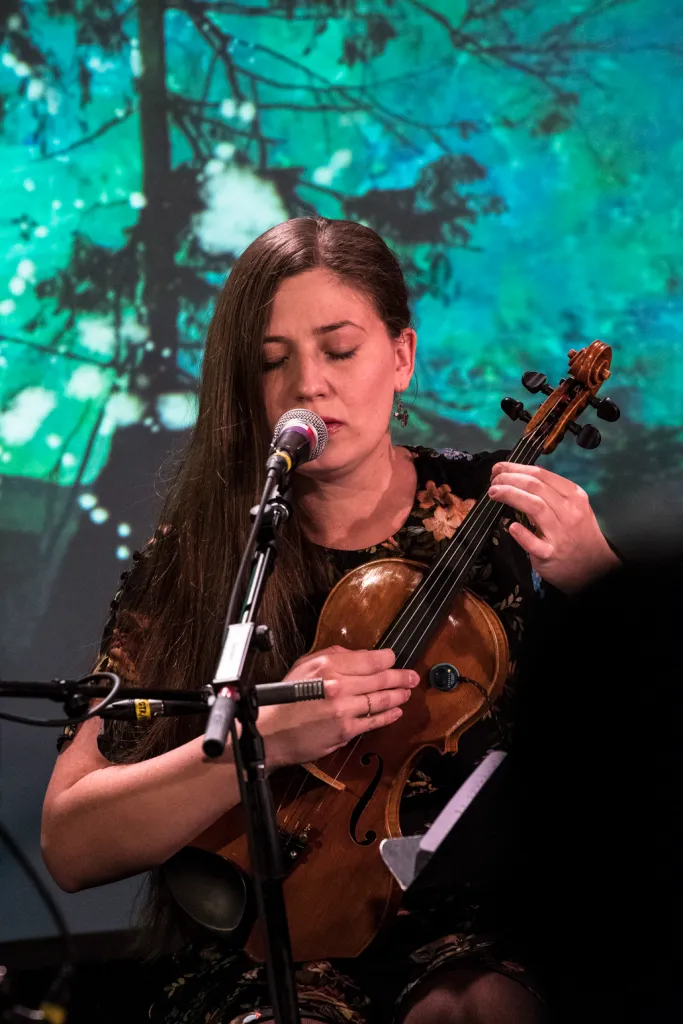
Clio Montrey (artist name: Clio Em) is a composer, writer, singer, multi-instrumentalist and gamedev who weaves imaginary worlds. She is the producer for Dungeons of Hinterberg (Microbird Games, 2024) and recently composed the OST for Canvas of Thoughts (Bandaloop). She is passionate about game worldbuilding and wrote the chapter Building Fantasy Worlds Through Music for the book The Magic of Games (Edition Donau-Universität Krems). She has presented on musical worldbuilding in games at various conferences, such as Coding Medieval Worlds (University of Vienna) and Game Dev Days Graz (University of Graz). She was also on the research team of Barbara Lüneburg’s project TransCoding/What if?, a project about participatory art, based at the Kunstuni Graz (KUG).
Baroque Music and Astronomy Through the Lens of Games
FROG 2026 – Talk
I present the Proof of Concept and an analysis of my upcoming game Arc of Venus, where musician and Astronomer Rosalia makes her way through Baroque Europe in order to act upon her own astronomical discovery, which could shake the foundations of her era’s science. By investigating how the arts and sciences are portrayed and implemented in games, I examine the links between the arts, the natural sciences, and gamified experiences. World building is considered through the lens of historical events and creative works. I expand upon the links between game development, art, museums and collections, and academic institutions – how these can be resources for game developers, and conversely, how games can become resources for these institutions.
Alina Menten

Alina Menten is a lecturer and researcher in the Department of Digital Media at the University of Applied Sciences Upper Austria, Campus Hagenberg. She holds BAs in Media Design (RH Köln) and Scandinavian Studies (Universität zu Köln) and an MA in Game Development and Research (TH Köln). Her research spans game studies, media studies, and game design, with a particular focus on representations of history, landscape, and space in digital games. She also serves on the board of the Working Group for the Humanities and Digital Games (Arbeitskreis Geisteswissenschaften und Digitale Spiele, AKGWDS). Alongside her academic work, she works as a game and visual designer.
Romantic Landscapes, Dragestil and the Myth of Northernness in The Elder Scrolls V: Skyrim
FROG 2026 – Talk
The Elder Scrolls V: Skyrim (Bethesda 2011) constructs an atmospheric image of the North that draws, explicitly and implicitly, on ideas of European northernness. This paper argues that its environment design operates as a form of artistic appropriation: it quotes Romantic landscape aesthetics, the composed sightlines of the eighteenth-century English landscape garden, and the national-romantic Dragestil with its stave-church vocabulary, translating these art(-historical) forms into traversable, playable space.
Taking the early part of the main quest “Before the Storm” as a case study, the analysis reads the game as an interactive media text in which landscape, architecture and atmosphere function as cultural codes in Roland Barthes’s sense. Tundra plains, carved dragon heads, Viking-age longhouses and auroral skies are detached from their original contexts, recombined and aesthetically heightened. Drawing on Barthes’s concept of myth and Eugen Pfister’s political reading of it for digital games, the paper shows how this process charges such signs with seemingly natural meaning. The game world does not depict a real geography or culture; it stages an ideologically framed North as self-evident truth: a sublime, timeless wilderness, a pre-industrial social order, and a heroic warrior ideal.
This case makes visible what is at stake when art forms become playable. Skyrim reuses cultural heritage — landscape painting, vernacular architecture, saga literature — without the contextual framing. Its interactivity means players do not merely perceive the resulting myth but perform it. The paper therefore asks what responsibilities arise when artistic and art-historical forms are transferred into game systems, and how playful formats might make their own selections and exclusions legible instead of naturalising them.
Nathalie Melendez
Nathalie Melendez is an independent scholar, her research focuses in modern era and late medieval period. She completed her bachelor of laws in 2023, currently she is a member of the Medieval Social Media Society.
How manuscripts became pixelated artistic expression in the game Scriptorium: Master of Manuscripts
FROG 2026 – Talk
This research aims to analyze the videogame Scriptorium: Master of Manuscripts as a medium enabling players to create their own artworks inspired by real medieval illustrations. Through textual observation, the connection between video games and art will be briefly examined to go straight into the game mechanics of Scriptorium, including the story mode and sandbox. In the former, the player encounter medieval scribe challenges, such as creating with vague descriptions or depicting biblical subjects, while in the latter the players can let their creativity flow. This provides insight into the game community, examining how creations are built from real medieval works, fiction, or pure imagination but always using the provided illustrations. Furthermore, it will be explored how the community is supports the creation memes but also develop interest on history and original art forms. Additionally, developer studio statements are used to clarify copyright rules regarding creations, the limitations for commercial and non-commercial usage, and their openness to collaborate with institutions or cultural-educational projects. Finally, the research proposes ideas for practically integrating the game into culture and art contexts, such as allowing visitors to play the game on screens within a museum’s medieval section or utilizing it in the classroom.