

Sonja Gabriel

Sonja Gabriel works as a professor for media literacy at University Teacher College Vienna/Krems (Austria). Her primary focus of research is on digital game-based learning and using serious games and gamification for teaching different subjects at school and university as well as evaluation of various projects for learning with games and game-design approaches. Another focus of interest is the use of digital games for teaching values to players.

The potential of serious games in training people to become better citizens

FROG 2022 – Talk

Games – especially serious games – have become a vital part of teaching and learning within the last decades. Not only are they used to teach history, geography or maths but more and more to teach values and ethics. In Poland, for example the game This War of Mine was added to the official reading list for schools and should be used in ethics or social studies lessons. The questions that often arise are if ethics and morale can be taught at all and more specially when talking about digital game-based learning in how far are games better qualified to teach young people about freedom and oppression compared to other media. One reason quite often cited that games are a better choice of teaching material is motivation. The Self-Determination Theory by Ryan & Deci mentions three requirements for motivation: competence, autonomy and relatedness. Digital games, however, sometimes also use different means of motivation which are more of a gamified sort (like points, leaderboards) and which might work to keep players inside the game but not very likely to change their point of view or attitudes towards a certain topic. By having a closer look at some serious games dealing with freedom, oppression and anti war themes and contrasting the motivational structures used by game designers with Self-Determination Theory, the contribution wants to show if digital games have the potential to teach (Western society) values and guide players towards a better understanding of the concepts (re)presented in the game.

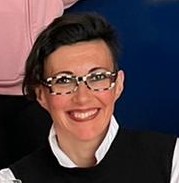
Stephanie Wössner

Stephanie Wössner is innovation team leader at the Landesmedienzentrum Baden-Württemberg. She is also a freelance consultant and speaker for future-oriented learning. Her areas of expertise are Extended Reality (XR), Game-based Learning (GBL) and Artificial Intelligence (AI), as well as design and futures thinking and the Metaverse.

Let‘s play! Future-oriented learning with games

FROG 2022 – Talk

Digital devices have become increasingly popular in classrooms and come with a great potential of transforming learning. Nevertheless, teachers continue to prepare “lessons” and implement them instead of letting Gen Z and Gen Alpha become agents of their own learning and taking on the role of learning partners. However, it is becoming increasingly apparent that neither the use of devices per se nor good lesson planning and implementation are a guarantee for “learning success” and learner motivation – or a good future. But how can this be explained?
In a nutshell: future-oriented learning requires us to reconsider everything we take for granted. Therefore, it is time to leave the familiar paths and come up with ideas on how we can support learners in learning the things they will need for their future as responsible (German, European, world) citizens in the digital age and provide them with the skills that will enable them to shape their (and our) future.

Game-based learning is of particular interest in this context because learning opportunities can easily be designed using games. It is of utmost importance that learners actively create and share content in cooperation with their peers.

After a brief look at the world we live in, we will consider a few future-oriented pedagogical approaches anyone can use to design learning experiences and adventures. We will then focus on three concrete examples:

  • Designing a sustainable future with Minetest
  • Making sure democracy will prevail by approaching This War of Mine from different angles (e.g. analysis, game design, creative gaming)
  • Experiencing gender and diversity through the Sims 4

Luana Silveri

Luana Silveri PhD., formerly a researcher in ecology with expertise in Freshwater ecology and climate change, now biology and chemistry teacher at the Rosa Bianca – Weisse rose high school and Ph.D. researcher at the Free University of Bozen in Didactic of science and game-based learning. Passionate for games especially board games, outdoor activities lover, and happy teacher.

A science teacher in the game designer shoes – the YouTopia game experience, a journey through ecology concepts, didactic needs, and game design.

FROG 2022 – Poster

Some papers report that many teachers are quite skeptical on the efficacy of games for deep learning in high school students however, there is a consistent set of literature confirming that game-based learning (GBL) can be effective in education, engaging students, and improving life skills and key competencies. In the last years a new GBL perspective is growing, the game development as an effective tool to foster both: teacher consciousness of GBL effectiveness and students STEM competencies and science knowledge.
After the lockdown as science teacher at the high school, some key questions came into my mind: how support students in coming back to school, to the relationships, in deepening scientific topics and in developing system thinking skills and other 21st-century skills. A small team made by 2 teachers, passionate in gaming, together with 10 students decided to develop a board game to support students in dealing with complex ecological concepts, system thinking and future scenario building ability.
This study describes the development process done by the team and are presented the lessons learnt and observations, which may provide insights on how game-based learning can remove barriers to the process of innovating the way we teach and learn.

Pedagogical principles and learning outcomes were defined by teachers and students, ecological topics and game mechanics were decided and developed by students as well as graphical elements. The final output of the creative process has been YouTopia – the ecosystem valley, a cooperative board game focused on sustainability, ecosystems, and climate change adaptation strategies.

Luana Silveri PhD., formerly research in ecology with an expertise in Freshwater ecology and climate change, now biology and chemistry teacher at the Rosa Bianca – Weisse rose high school and PhD researcher at Free University of Bozen in Didactic of science and game-based learning. Passionate for games especially board games, outdoor activities lover and happy teacher.


Harald Koberg

Harald is a games researcher, media pedagogue and cultural mediator based around Graz, Austria. He works for the Styrian Government as an expert in digital culture. At Ludovico – an NGO focusing on the culture and pedagogics of play – he is responsible for all activities concerning digital play and organizes the annual button Festival of Gaming Culture. He frequently speaks and teaches at the University of Graz and other universities and educational institutions. His first book »Freies Spiel: Digitales Spielen und die Sehnsucht nach Wirkmächtigkeit« was published by Büchner Verlag.

For Play’s Sake: What makes us play and how we can fight it

FROG 2022 – Keynote

It’s not play if you have to. That is one part of a definition of play that most of us might be able to agree on. Foucault probably wouldn’t. Because it is power structures that make us decide. What we want can never be fully separated from what we ought to want. And games offer counter-places and counter-publics to live up to those needs.

To play, at the same time, is to be rebellious. It’s about choosing new sets of rules and testing them. But it’s happening in the in-betweens of the analogue and the digital, reality and fiction, the actual and the virtual, earnestness and fun. And it’s happening on the turfs of huge corporations. So how rebellious can it be?

Based on his qualitative research among players and their social surroundings, Harald understands play as a source of experiences of empowerment. He analyses them against the background of social realities that are increasingly guided by what is being called libertarian paternalism and that invoke in many people a feeling of not being able to reach what they are owed or supposed to achieve.

In this talk he will ask how real this empowerment can be and how it might impact social dynamics. Are games the padded cells of a system that lets us romp and rage for a while, until we are ready to fit in again, into the roles it has in store for us? Or might they also encourage us to rethink the system itself?